Thursday, March 31, 2016

SEO tips for online business

(forwarded from http://blog.teamtreehouse.com/)
Search engine optimization, or SEO, has been around long enough for people to understand that it’s an effective acquisition channel. The only problem is that there has been a lot of bad press regarding SEO because of people claiming to deliver on promises and then failing. The truth is SEO isn’t that hard once you start to get a hang of it. And once you get a hang of it, you’ll start to see your traffic start to grow.
Here are 5 tips to increase your organic (SEO) traffic:

1. Internal Linking

Sure, everyone talks about how external back links are better than internal back links, and they’re right. But that doesn’t mean you should ignore internal links.
Internal links help guide the search engines through your site. Without internal links, search engines have a harder time figuring out where they should go next. It’s your job to make it easier on them to find your important pages. The harder you make it for the search engines, the more likely it is that important pages will be missed by the spiders. And that means lost traffic.
You don’t want lost traffic right?
Here are 3 examples of how Zappos kills it with internal linking. Also note that Zappos does a great job with SEO, but the site isn’t being ‘SEO’ed’ or ‘manipulated’ in any way.

a. Breadcrumbs

breadcrumbs
Breadcrumbs funnel link juice to the home page, categories, and sub categories. By adding breadcrumbs you’re adding a layer of internal links across your site. In short, your site becomes a little more accessible to search engines.
Think of your site as an ant hill. Your homepage is the top of the funnel and your categories/sub-categories are the little sections in the middle of the ant hill. Internal links are what will help build more tunnels.

b. Content + internal links

Here’s a snippet of content on the ‘Shoes’ category for Zappos:
about-shoes
This does two things. The first sets the foundation for internal linking and also brings more relevance to the page: content. This section tells the search engine that this page is about different shoes and makes it easier for this page to rank for ‘shoes’ related keywords. The second part is internal linking with rich anchor text. These are the types of keywords that Zappos wants to rank higher for.
Ranking higher usually means more traffic and more traffic for an e-commerce means more conversions. Careful that you don’t overdo this though. You could get penalized.

c. Related links

Here’s a look at a Zappos product page:
related-links
These related product links do quite a few things for Zappos. As you know by now, links are part of the equation when a search engine determines how important a page is. With e-commerce SEO, there are thousands of products and it’s hard to give each product some link love. Linking to related products spreads the link juice around relevant products so they all get a small boost. Let’s also not forget about the increased chances of getting an extra conversion by linking to related products.
If you don’t have an e-commerce site, no problem. Blogs can take advantage of great related internal linking by doing something like this:
related-articles

2. Great content

I know, I know. They say everywhere that content is king and content marketing has been a growing trend in online marketing. For example, BufferApp grew its their customer base from 0 to 100,000 with content marketing. Another good example is Fraiser Cain growing his monthly traffic from 0 to 3 million visitors with content marketing.
content-marketing-meme
The truth is, great content is extremely powerful and separates the wheat from the chaffe. Let’s look at some benefits of great content:
  • Establishes you as a thought leader – this can lead to unforeseen opportunities (such as speaking or consulting gigs)
  • Attracts links – if your post is really good, you can expect to get links from high quality sources. It sure beats having to manually prospect for links.
  • Attracts social shares – social shares are now part of the SEO equation and will bring in more traffic. This can even result in more links.
  • Brings traffic to your site – if your content is evergreen, then expect that traffic to last for awhile.
  • Builds trust with your audience – the blog is an excellent point in your sales funnel because people tend to remember people that helped them. Let’s say you sold toilets and you had a blog about home improvement and someone has gone to your blog for tips on multiple occasions. Who do you think they will turn to when they need a new toilet? It’s all about helping others.
Keep one thing in mind though, creating great content is not only really hard, but it also takes a long time.
Content marketing can be one of your biggest competitive advantages if you can execute. Some of the most successful bloggers on the internet took years to build up their blog. Slow and steady wins the race so be patient!

3. Great relationships

Link building is still one of the most important aspects of SEO. Assuming you have your on-site/technical SEO taken care of, links can really be a traffic driver if used correctly. The problem here is links are really hard to acquire. Good links are even tougher to acquire. And with the recent Google Penguin update, you don’t want to be messing around with too many dirty links. You want the good stuff.
So what’s a good way to acquire links? Relationships.
Seems like an underwhelming answer huh? But I assure you that building great relationships with people will yield you some of the highest quality links you’ve ever seen. It’ll take you some time to develop these but they’ll be worth it. And you’ll get a lot more than a few links if you play your cards right.
If you want to start building these relationships, you can look for influencers online or go to offline events. After that, it’s a matter of following up and helping people before you expect anything back.
I guarantee you’ll feel much more satisfied from building a relationship versus building a few links.

4. Transcriptions

First, an example of a transcription done right:
seomoz-transcription
If you ever wonder how certain websites rank for so many long tail keywords, it’s because they have a lot of content and a lot of links. The links tell the search engines that a particular site is authoritative so it tells the search engines that they should be placed higher in the search result pages because the site has pretty much earned it. Conversely, a newer site with no links and a lot of content wouldn’t do that well because it’s still relatively new and unestablished.
If you post video content, it’s smart to make use of transcriptions. Search engines can’t exactly crawl everything that’s being said in a video so it’s your job to make this content visible in text format. If you do that, you open yourself to ranking for more long tail keywords.

5. User Generated Content

Giving your users the option to produce content for you creates a sense of community and can even help with decision making. For example, just look at how Amazon’s product reviews:
amazon-review
Besides helping with a purchase decision, the content generated here is great for SEO. Search engine spiders like unique, helpful content and they get plenty of it from product reviews. This is also a big win for Amazon because they don’t have to spend more money to produce content – their customers are doing it for them!

Conclusion

If used correctly, SEO can be a very powerful weapon. Like anything else though, there are no shortcuts. And if you try to take shortcuts, you’ll eventually end up falling short because you’re competing against some of the smartest engineers in the world at Google. It’s best to invest in a long term strategy that adds value to your audience.
Try using one or two of the tactics above and see how it works out for you.
What are some other SEO tactics that have been effective for you?

A good way of finding refrigeration supplier in China - China Refrigeration 2016

If you are looking for a cold storage supplier or wants to see what's happening there in China refrigeration industry, you may want to visit the China Refrigeration Expo. This is a professional HVACR event in China, similar like the Euroshop trade fair in Germany every four years, China Refrigeration Expo is one of the most professional refrigeration event in China. 


The event will be held from April 7~9 at New China International Exhibition Center in BeijingBeijing this year, the location is below:

  • Exhibition Add:88,Yuxiang Rd., Tianzhu Area, Shunyi District, Beijing
  • By Shuttle Bus (Round-trip): Shuttle buses are available in every official hotels of the exhibition.
  • By Bus: No 915, 916, 918, 923, 934, 936, 942, 955, 970, 980 or 987 and get off at Maliandian or Hualikan shop.
  • By Metro: Line 15 to New China International Exhibition Center station directly.
  • By Self-Drive:
  • 1. Follow Jingcheng Expresway—Exit from Houshayu tollbooth—Drive onto Huosha Rd—Reach Luoma Roundabout—Go south for Yuxiang Rd—New China
  • International Exhibition Center is on your left side.
  • 2. head for Sanyuan Overcrossing—Enter Airport Higway—Yangling St—Maliandian Rd Junction—New China International Exhibtion Center is just around the
  • conter.
  • 3.Head for Sanyuan Overcossing—Take Jingshun Rd—Maliandian Rd Junction—New China International Exhibition Center is just around the corner. 


In this expo you can find Refrigeration, Air-conditioning, Heating and Ventilation, Frozen Food Processing, Packaging and Storage and of course our professions -- compressor racks for industry refrigeration.

Different from last year, other than ordinary Freon compressor racks, pump station and condensing unit, we are exhibiting these high light products below:

  1. R404a with CO2 secondary refrigerant inverter type compressor rack. This is a very good solution for -35 deg C fast frozen use. It uses R404a/R22 to cool down the CO2 and change it into liquid, then pump liquid CO2 to evaporators in cold rooms. Because the CO2 side does not contain oil, the refrigeration performance of the system will be very stable, only have 2 deg C temperature vibration, since the temperature is this stable, the evaporator is very hard to get frozen block, so it does not need to defrost frequently, almost once a week. The system uses inverter type Kobelco brand two stage screw compressor. It can adjust it's frequency according to the system needs.  Different from normal compressor with external inverter, this compressor can both decrease it's speed and also enlarge it's frequency and bring up it's speed to above 3000 rpm, so that it has wider output. The working CO2 pressure is only around 7~8kg, because CO2 is much much cheaper than freon and is not toxic as ammonia, This solution is a little bit more expensive than freon system, but can reduce more than 20% electricity, compared with ammonia system, it's high effeciency, simple and cheaper.
  2. Heat pump is one of our new product. With R134a Fusheng brand compressor, it can produce 80 deg C hot water and 3 deg C cold water at the same time. It's designed for poultry feather treatment.
  3. Small screw compressor is a new trend in the market, this market we are exhibiting 30hp*3 screw type compressor racks, this will be a very good equipment for small cold stores.
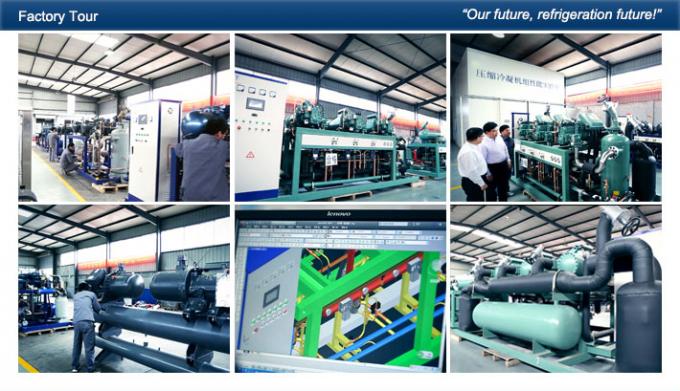
We will be more than happy to meet you in person, if your time allows, we can take you visit our factory or see some cold storage projects.


If you are not able to come this time, you can check our factory introduction video below:


We sincerely look forward to meeting friends from all over the world. During your stay in China, if you need translation or met problems, you can find me by calling +86-18678897804, I will do my best to help. 

Saturday, February 27, 2016

Foiling Frosted Evaporator Coils

Reduced airflow over the coil can cause a multitude of woes

Forwarded from link
FIGURE 1: An evaporator in a walk-in cooler has frost blocking much of the airflow from entering the coil.
Frost on an evaporator coil will prevent the correct amount of airflow across the coil. Any time an evaporator coil sees reduced airflow across its face, there will be a reduced heat load on the coil. No airflow will cause the refrigerant in the coil to remain a liquid and not vaporize. This liquid refrigerant will travel on past the evaporator coil and eventually get to the compressor. Compressor damage will soon occur from flooding and/or slugging.
Here are some of the ways airflow over the evaporator can become restricted:
• Frosted evaporator coil from bad defrost heater;
• Frosted evaporator coil from high humidity;
• Frosted evaporator coil from evaporator fan out;
• Frosted evaporator coil from defrost component malfunctions;
• Frosted evaporator from no load on the evaporator coil;
• Dirty evaporator coil; and
• Defrost intervals set too far apart.
Figure No. 1 shows a frosted evaporator coil in a walk-in cooler blocking a lot of airflow from entering the coil.

A COMMON CULPRIT: FROST

Frost is the most common cause of inefficiency in evaporator coils. When the evaporator’s coil temperature drops below the dew point temperature, dew will begin to collect on the evaporator’s cool surface. (The dew point temperature is the temperature where dew starts to form.) If the temperature of the evaporator coil continues to drop below the freezing point of water, the moisture on the evaporator’s coil will begin to freeze into a thin layer of ice.
The first thin layer of ice on the evaporator coil is very hard and will actually enhance the evaporator’s efficiency. Not only is this first layer of solid ice around the evaporator coil a good conductor of heat, it also will increase the surface area of the evaporator tubes. Thus, heat transferred into the evaporator’s coil will be increased. Now that the evaporator tubes have an increased surface area, the area for airflow around the tubes will be reduced. This will cause a slight increase in the air’s velocity through the coil, which will also increase heat transfer to the evaporator.
Depending on humidity, evaporator temperature, and airflow, the subsequent layers of frost that accumulate on the evaporator may be more crystalline or snow-like. These layers of frost will hold more entrained air and will be very porous. This type of frost — often referred to as radiant frost or hoar frost — will insulate the evaporator and severely reduce its heat-absorbing ability.
As the hoar frost accumulates, the evaporator will see less heat from the refrigerated space. This will cause the evaporator or suction pressure to drop, and the evaporator coil will become colder. Higher compression ratios cause lower compressor volumetric efficiencies, less dense refrigerant return gases entering the compressor, reduced mass flow rates of refrigerant, and loss of system capacity. As a result of this insulating effect, the temperature of the evaporator coil must be reduced to maintain the same desired refrigerated space temperature. Now, the temperature difference (TD) between the evaporator coil and the refrigerated space will be greater.
In many cases, technicians will change out a compressor because of broken internal parts and not find the actual cause of the problem. Broken compressor parts are not the cause.
The cause could have been a faulty time clock or an open defrost heater not letting the system defrost. This would frost or ice the evaporator coil, causing flooding or slugging of the compressor. This, in turn, probably caused the broken internal parts. If the technician did not run a system checklist and run the system through its modes after changing the compressor, the new compressor is sure to fail from the same causes.
Compressor manufacturers are asking technicians to examine broken compressors for the cause of failure. Opening a semi-hermetic compressor and examining its internal parts does not void the warranty as long as all of the parts are returned with the old compressor.
Technicians should then make a list of the causes that could be blamed for this failure and, once the system is up and running, eliminate them, one by one. As mentioned before, an open defrost heater could be the cause. If the system is not test-run and put through the defrost mode, or systematically checked with an ohmmeter and voltmeter, the real problem of an open defrost heater will never be found, and the replacement compressor will soon fail. It is suggested that causes and symptoms be listed and system checklists be made when systematically troubleshooting systems. Shown above is a system check for an R-134a system with an evaporator that has major frost accumulation.

SYMPTOMS OF REDUCED AIRFLOW

• Low discharge temperatures;
• Low head pressures;
• Low condenser splits;
• Low-to-normal evaporator (suction) pressures;
• Low superheats;
• Cold compressor crankcase; and
• High to normal amp draw.
Low discharge temperature — Since the superheats are low and the evaporator and compressor could be flooding, the compression stroke could contain liquid entrained with vapor (wet compression). The heat of compression will hopefully vaporize any liquid. This vaporization process needs heat and will get it from the heat of compression. This will take heat away from the cylinder and leave a colder discharge temperature. Discharge temperatures could even be cooler than the condensing temperature. This would be a sure sign of liquid being vaporized by the compression stroke. In other words, wet compression is taking place. If wet compression is severe enough, head bolts have been known to strip and discharge valves may ruin due to hydraulic pressures. These pressures build up from trying to compress liquid refrigerant.
Low condensing (head) pressures — The restricted airflow over the evaporator coil will cause the refrigerant in the evaporator not to see a heat load; thus, it will not be completely vaporized. With no heat load to be rejected in the condenser, the condensing pressure and temperature does not have to elevate to reject heat to the ambient. Low condensing pressures are the result.
Low condenser splits — With condensing pressures and temperatures low, the condensing split will be low. The condenser does not have to elevate its temperature to reject the small heat load.
Low evaporator (suction) pressures — Because of the reduced heat load seeing the evaporator coil, the refrigerant vaporization rate and amount will be reduced. This will give lower vapor pressures in the low side of the system.
Low superheats — Because the heat load on the evaporator coil is reduced, not much refrigerant will be vaporizing. The 100 percent saturated vapor point in the evaporator will crawl down past the end of the evaporator, and the thermostatic expansion valve (TXV) usually loses control. Compressors can slug and/or flood in these situations.
Cold compressor crankcase — Since the compressor (total) superheat is low, sometime during the on cycle, the compressor will flood or slug. There will be liquid refrigerant in the compressor’s crankcase boiling off. This will flash the oil and will cause compressor damage. It is the boiling of refrigerant in the crankcase that will make the crankcase cold to the touch. The crankcase may even sweat or frost if conditions are right.
High to normal amp draw — Since droplets of liquid refrigerant will be entrained with the suction vapors, the density of the refrigerant coming from the suction line will be high. Some refrigerant may even be in the liquid form. This will require more work from the compressor, and the amp draw may be a bit high, depending on the severity of the flooding or slugging.

Thursday, February 18, 2016

Touch screen of our compressor rack in use.


This is the touch screen of our compressor rack, this is a wakame cold store project, 3 floors, each floor is 5.5m high, 2500 square meters, totally 7500 square meters.
Cooling 10 tons per 36h, cold store temperature -40 deg C, wakame center temperature -28 deg C.
Compressor brand Bitzer
Compressor rack manufacturer: Jinan Ourfuture Refrigeration Equipment Co., Ltd.
WhatsApp/Viber/Cellphone: +86-18678897804
Skype: bluemic986
email: mike@refrigerationcompressorunit.com


Monday, January 25, 2016

Panasonic is buying Hussmann in the US to expand in food display cabinet business - Dec 21, 2015

Content forwarded from industry week, link:
http://www.industryweek.com/global-economy/panasonic-buys-us-refrigeration-company-hussmann
TOKYO — Japanese electronics giant Panasonic announced Monday that it would buy Hussmann, a U.S.-based food refrigeration systems company, for $1.54 billion as part of its drive to expand in the American food retail sector.
Panasonic said in a statement that the purchase would help it to increase its business for freezer display cases in the United States — the world’s biggest market for the product — as well as to areas near the giant economy and markets such as Australia and New Zealand.
Calling the deal a “strategic acquisition,” Osaka-based Panasonic said the purchase would combine the Hussmann’s excellence in customer service and maintenance with Panasonic technology.
“Panasonic will use this synergy to drive growth and further innovation on a global basis,” the company said in a release.
The purchase will be completed in April 2016, making the U.S. firm a wholly-owned subsidiary, Panasonic said. The Hussmann brand and the current management will remain.
Major Japanese companies have been rushing to buy foreign firms as a way to secure future growth. The Japanese domestic market has faced chronically weak consumption, and the nation’s shrinking population has posed a threat to Japan’s growth prospects. 
Copyright Agence France-Presse, 2015


Friday, January 15, 2016

Congratulation on Successfully Delivered -55℃ Tuna Fish Cold Room

In late 2012 Jinan Ourfuture Refrigeration Equipment Co., Ltd successfully accomplished the final installation and commissioning of a -55℃ tuna fish cold storage in Weihai city, Shandong province of China. We use Taiwan Fusheng brand two stage low temperature screw type parallel compressor racks. This means we have became the first company in China who successfully delivered 10,000 tons level super low temperature compressor racks for cold room chamber.


Tuna fish is ocean fish, doesn’t have inland pollution affection, the fresh tuna fish meat is very tasty and contains lots of nutrition that do good to human body. To deliver the best tuna fish quality, it requires a frozen temperature of -60℃, the long time storage temperature is -50℃~-55℃. High quality tuna fish must have good freshness and remain it’s special fresh red color. In the fishing process, other than careful pre-treatment on vessel, must pay special attention to the fast frozen process, the work is pretty complex, first we need to know some basic information:

1. Must use -60℃ super low temperature for fast frozen
When the tuna fish frozen process started, the water inside a fish cell started to crystallize at -1.5℃, till -60℃ all the water inside the cell will be completely. So the eutectic point of tuna fish is -60℃, meaning when the temperature is -60℃, the tuna fish can be fully frozen, the tuna cell function is completely stopped, so that the tuna can remain fresh for long period. If the temperature doesn’t drop to -60℃, part of the tuna cell will not be frozen and will go bad, under long term storage, this will make the fish turn black. Usually in China, from tuna harvest to it’s finally consumed, it takes around a half year, so, in order to keep the freshness, the frozen temperature must reach to -60℃, in this kind of environment, the fish can be maintained from one and a half year to two years.

2. Must use super fast frozen technology
When the frozen process started, from -1.5℃ to -5.5℃ the frozen water crystal inside a cell has the largest volume and this will easily damage the cell. If the cell is broken, when we thaw the fish, water will leak from fish cells, take away the special tuna taste, low the quality. So in order to remain the tuna fish quality, we should use fast frozen technology, reduce the frozen time especially the time the tuna fish is under -1.5℃ to -5.5℃. Reduce the fast frozen time is the key of frozen tuna fish. 

Here are something suggestions:
1) Low the blast freezer temperature as much as possible, when blast freezer temperature is -60℃, the time to pass the “-1.5℃ to -5.5℃” is around 3~4 hours, but if the blast freezer temperature is -30℃, this process will take around 8~9 hours.
2) Enlarge the heat exchange rate of fish body surface. This heat exchange rate is decided by the ventilation speed of fish body surface. So under normal circumstance, the wind around the fish body will take away 90% heat from the fish, however, the frozen tray under the fish can only take away 10%.

Written and edited by mike, for more info please follow @ldmichael on twitter

Jinan Ourfuture Refrigeration Equipment Co., Ltd.
mike@refrigerationcompressorunit.com
“Our future, refrigeration future!”


"Jinan Ourfuture Refrigeration Equipment Co., Ltd is one of the leading cold room compressor rack manufacturer in China, mainly produce parallel compressor racks, condensing unit, cold room solution, walk-in freezer, food display cabinet and refrigeration retrofit products, We serve our customers with advanced technology and excellent service."

Company introduction on Youtube: https://youtu.be/XvOgRekZbns